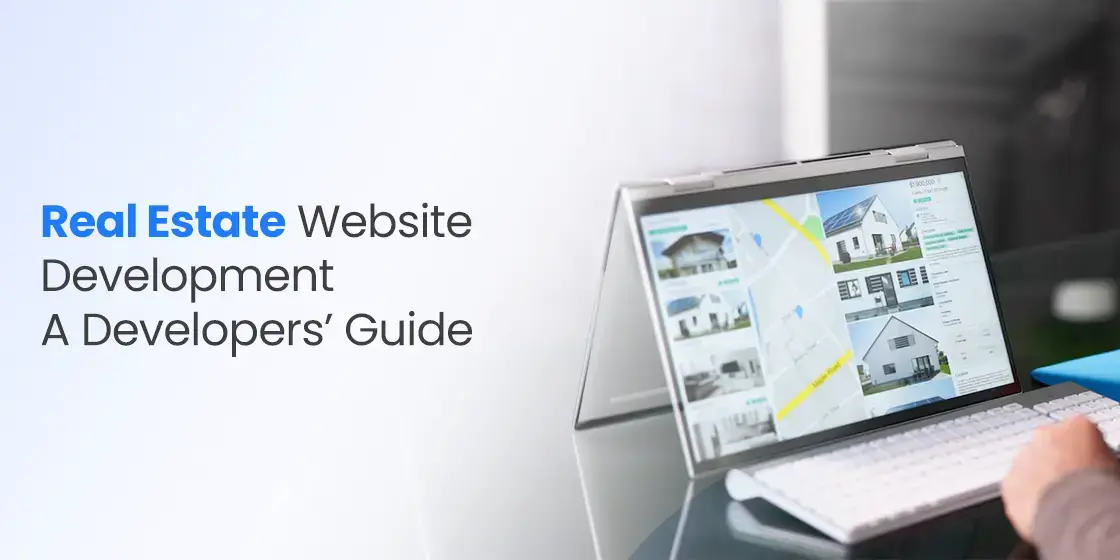
A real estate website is the first place most buyers meet you. 95% of home buyers use online tools during their property search, and 71% find their property on a mobile device. If your site loads slowly, hides listings behind clunky filters, or feels like a 2015 brochure, you’re losing leads before the first handshake.
That’s the gap real estate website development is meant to close. The industry has moved past static listing pages into a world of AI-powered search, IDX/MLS integration, 3D virtual tours, and CRM-connected lead capture. Whether you’re a brokerage, a property management firm, a luxury agency, or a PropTech startup, your website is your most productive salesperson. It works while you sleep, and it never takes a day off.
This guide walks you through everything that goes into building a real estate website in 2026. You’ll learn the types of platforms you can build, the features that actually matter, what it costs, how long it takes, and how to choose a real estate website development company that builds for conversions, not just compliments.
What Is Real Estate Website Development?
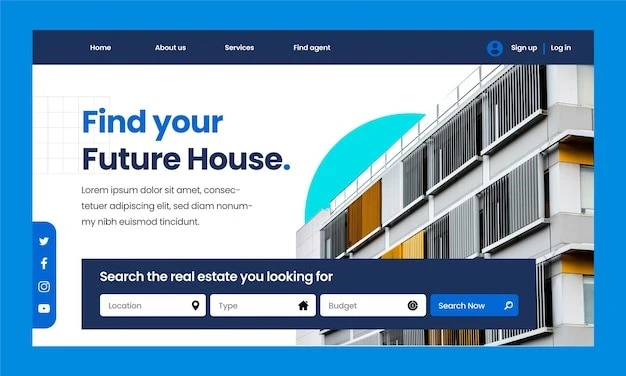
Real estate website development is the process of designing, building, and launching a web platform that lets users browse property listings, connect with agents, and complete transactions online. Modern real estate web development goes beyond static pages. It includes IDX/MLS feeds, AI property matching, CRM integration, online payments, and analytics that turn visitors into qualified leads.
A good real estate website is three things at once: a storefront, a sales engine, and a database. It displays properties with high-quality media, captures inquiries through smart forms, and feeds that data straight into the tools your agents already use. Every design and engineering choice should push visitors closer to a conversation with your team.
Why Does Real Estate Website Development Matter in 2026?
Real estate website development matters in 2026 because property buyers now research, compare, and shortlist homes almost entirely online before ever calling an agent. A well-built website gives you ownership of the lead, control over the brand, and a measurable edge over competitors still relying on broker subpages or social profiles they don’t own.
The numbers are hard to argue with. Video listings get 403% more inquiries than listings without video, virtual tours can cut time-to-sale by 20%, and real estate companies that maintain active blogs generate 5.4 times more leads than those that don’t. A website isn’t a cost center anymore. It’s the single highest-leverage asset your business can own.
There’s also a trust angle. 88% of buyers purchase their home through a real estate agent, and they almost always vet that agent online first. A slow, outdated, or generic website signals a lack of attention to detail. In a market where buyers are more selective than ever, that first impression can cost you a six-figure commission.
What Types of Real Estate Websites Can You Build?
Real estate website development covers several distinct platform types, each with its own audience, feature set, and technical requirements. Choosing the right type is the first decision that shapes the rest of your build. Here are the most common ones we help clients build.
Real Estate Marketplaces
Marketplaces aggregate listings from many agencies and sellers into one searchable hub. Think Zillow, Realtor.com, Property Finder, and Dubizzle. Zillow alone receives around 2.8 billion visits per year, which tells you everything about how much traffic a well-executed marketplace can capture.
These platforms live or die on three things: data quality, search performance, and trust. If you’re planning to build one, the work that goes into a marketplace is closer to real estate app development for a platform like Property Finder than a simple agent site.
Agency and Brokerage Websites
These are the most common real estate websites: company sites for brokerages and teams that showcase their own listings, agents, and local expertise. The design priority is brand credibility and lead capture, not marketplace-scale search. Agency sites typically feature curated listings, team bios, neighborhood guides, and gated market reports.
Property Listing and Individual Agent Sites
Individual realtors often need their own site separate from their brokerage. Owning the domain matters here: if an agent switches brokerages, a site they own carries all their SEO authority, backlinks, and past lead history with them. Realtor website development for solo agents usually focuses on personal branding, local SEO pages, and IDX feeds.
Rental and Short-Term Lease Websites
Rental sites serve a different user journey than sale-focused platforms. Renters care about move-in dates, lease terms, pet policies, and deposits more than school districts or resale value. These sites often integrate background checks, digital lease signing, and recurring rent payments through gateways like Stripe or local equivalents.
Property Management Portals
Property management sites are workflow tools, not marketing tools. They serve landlords, tenants, and maintenance teams with features like rent tracking, maintenance ticketing, accounting integrations, and document storage. Building one has more in common with enterprise software development than a standard listing site.
Luxury and Niche Portals
Luxury and niche portals focus on a specific slice of the market: ultra-high-net-worth homes, commercial real estate, specific architectural styles, or regional markets. The design bar is higher, the listing volume is lower, and storytelling matters as much as search. These sites often lean on cinematic video, editorial copy, and 3D Matterport tours over raw listing counts.
What Features Must Every Real Estate Website Include?
Every real estate website in 2026 needs a core set of features to compete: fast IDX/MLS-powered search, advanced filters, a high-quality media system, mobile-first design, CRM-connected lead forms, and clear CTAs. These aren’t nice-to-haves. They’re the baseline users expect before they’ll even consider contacting you.
Below are the non-negotiable features your real estate web development plan should include.
IDX and MLS Integration
IDX (Internet Data Exchange) and MLS (Multiple Listing Service) integrations let your site display live, accurate listings pulled from a broader network. In the US, IDX is essentially a requirement for any serious real estate website. In markets like the UAE, integrations with Property Finder, Bayut, or Dubizzle feeds serve the same role.
The engineering challenge is real. MLS feeds can run into hundreds of thousands of listings, each with photos, price updates, and status changes that need to sync in near real time. Expect to spend serious effort on caching, API rate limits, and data hygiene.
Advanced Search and Map-Based Filters
Users want to filter by price, bedrooms, neighborhood, lot size, amenities, commute time, school ratings, and more. A powerful, fast search engine with interactive map filtering is the single feature that most separates high-performing real estate sites from the rest.
Technically, this usually means Elasticsearch or an equivalent search layer sitting in front of your database, plus a map layer like Google Maps or Mapbox with custom clustering for dense listing areas.
Mobile-First, Speed-Optimized Design
Most property searches start on a phone. Mobile-first design isn’t a trend. It’s the default. Target under three seconds of load time on 4G connections, and aim for Core Web Vitals scores above 90 in PageSpeed Insights. Lazy-load photo galleries, compress hero images, and keep JavaScript bundles tight.
High-Quality Photo, Video, and 3D Media Galleries
Every listing page needs room for professional photos, drone footage, video walkthroughs, floor plans, and increasingly, 3D virtual tours. Use a CDN to serve media globally, and automatically generate multiple sizes so the right image loads on the right device.
Smart Lead Capture Forms and CRM Integration
Lead capture is where most real estate websites leak revenue. Forms should be short, context-aware (a form on a rental page asks different questions than one on a luxury villa page), and pre-filled wherever possible. Every submission should flow directly into your CRM so no lead gets lost in a shared inbox.
Saved Searches, Favorites, and User Accounts
Logged-in users convert better. Let visitors save searches, favorite properties, set price-drop alerts, and compare listings side by side. Accounts also give you first-party data you can use for retargeting, AI personalization, and email nurture campaigns.
In-Site Messaging, WhatsApp, and Click-to-Call
In-site messaging, WhatsApp buttons, and click-to-call CTAs let users choose how they want to reach out. According to Google and BrightLocal, 78% of local searches result in a call, email, or visit within 24 hours, so the path to a conversation needs to be visible on every page, especially on mobile.
Web Experiences
Enhance your online presence with visually appealing and functional websites. Discover our custom web solutions.
Discover Web Solutions
What Advanced Features Will Set Your Real Estate Website Apart?
Advanced features that separate a 2026 real estate website from an average one include AI property recommendations, 3D/Matterport virtual tours, conversational chatbots, hyper-local neighborhood pages, mortgage and tax calculators, and CRM-powered marketing automation. These aren’t gimmicks. They directly improve lead quality, time-on-site, and conversion rates.
AI-Powered Property Recommendations
AI recommendation engines analyze behavior (listings viewed, filters applied, saved searches, time spent on certain pages) to suggest properties that actually fit a user’s preferences. Done well, this feels less like a feature and more like a 24/7 sales engine that keeps leads engaged between agent touchpoints.
3D Virtual Tours and Matterport Integration
Virtual tours have gone from pandemic-era novelty to industry standard. Embedded Matterport or equivalent 3D walkthroughs let out-of-town buyers shortlist faster, filter out tire-kickers, and commit to in-person viewings with more intent. They also photograph exceptionally well in social previews, which helps with organic reach.
Conversational AI Chatbots
Modern real estate chatbots do more than answer FAQs. They qualify leads, book viewings directly into agent calendars, and hand off warm prospects with full context. If you’re curious how the underlying tech works, our guide on how to build an AI chatbot walks through the architecture.
Hyper-Local Neighborhood and Market Pages
“Homes for sale near me” and variations on “homes in [neighborhood]” are among the fastest-growing categories of real estate searches. Google Trends data shows these hyper-local queries have grown 340% since 2019. Dedicated neighborhood pages with local stats, school data, and market reports can turn your site into a local SEO magnet.
Mortgage, Affordability, and Tax Calculators
Interactive calculators keep users on-site and help them make faster decisions. Include mortgage payment estimators, affordability calculators, property tax estimators, and closing cost breakdowns. Tie these directly into lead forms so a high-intent user who runs a calculation is gently nudged toward a contact CTA.
Online Scheduling and Realtor Calendars
Let users book property viewings, video calls, and consultations directly from a listing page. Calendar tools synced to agent availability cut the friction between interest and appointment, which is often where deals go cold.
Blockchain-Backed Transactions and Tokenized Listings
Still early, but worth watching. Blockchain-based property transactions can potentially reduce closing times from 30 to 60 days down to under 10, according to Deloitte’s PropTech research. For forward-looking portals and commercial platforms, building with tokenization and smart contracts in mind is a reasonable bet.
Which Tech Stack Is Best for Real Estate Website Development?
There’s no single “best” stack for real estate website development, but most successful 2026 builds share a common shape: a fast frontend framework (Next.js, Nuxt, or Astro), a headless CMS or custom backend (Node.js, .NET, or Laravel), a search layer (Elasticsearch or Algolia), a map provider (Mapbox or Google Maps), and a cloud host (AWS, Azure, or Google Cloud) with a CDN for media.
For small brokerages and solo agents, a customized WordPress build with an IDX plugin is often enough. For marketplaces and PropTech platforms with heavy custom logic, a fully custom stack pays for itself in performance and scalability. The right call depends on your listing volume, traffic expectations, and integration needs.
| Layer | Common Choices | Best For |
| Frontend | Next.js, Nuxt, Astro, React | SEO-friendly, fast-loading pages |
| Backend / CMS | Node.js, .NET, Laravel, Strapi, WordPress | Custom logic, content management |
| Search | Elasticsearch, Algolia, Meilisearch | Large catalogs, advanced filters |
| Maps | Google Maps, Mapbox | Interactive map search, clustering |
| Database | PostgreSQL, MongoDB | Listing data, user accounts |
| Hosting / Cloud | AWS, Azure, Google Cloud, Vercel | Scale, CDN, global performance |
| Media / CDN | Cloudinary, Cloudflare, AWS CloudFront | Fast photo, video, 3D tour delivery |
If you’re weighing WordPress against a fully custom build, our breakdown of custom WordPress website development covers when each approach is the smarter investment.
How Much Does Real Estate Website Development Cost?
Real estate website development costs in 2026 typically range from around $3,000 for a template-based WordPress site for a solo agent to $150,000+ for a custom-built marketplace or PropTech platform. The biggest cost drivers are feature scope (basic listings vs. IDX, AI, 3D tours), integrations (CRM, payments, MLS), and whether you go template-based, semi-custom, or fully custom.
Here’s how real estate website development pricing usually breaks down.
| Project Type | What’s Included | Estimated Cost (USD) | Timeline |
| Template / Builder (Wix, Squarespace, WordPress theme) | Basic listings, contact form, simple IDX plugin | $500 – $3,000 | 2 – 4 weeks |
| Custom WordPress Brokerage Site | Custom design, IDX, CRM integration, blog, neighborhood pages | $5,000 – $25,000 | 6 – 12 weeks |
| Mid-Market Custom Build | Advanced search, map filters, user accounts, AI recommendations, basic chatbot | $25,000 – $75,000 | 3 – 5 months |
| Enterprise Marketplace / PropTech Platform | MLS/IDX at scale, AI matching, 3D tours, CRM, mobile app, analytics | $75,000 – $250,000+ | 6 – 12+ months |
These ranges assume standard development rates; offshore and nearshore teams in regions like Dubai, South Asia, and Eastern Europe can deliver the same scope at a meaningful discount vs. US/UK rates. If you’re building a full-scale property portal, our guide on the cost to develop a real estate app like Property Finder breaks down the numbers in more detail.
How Long Does It Take to Build a Real Estate Website?
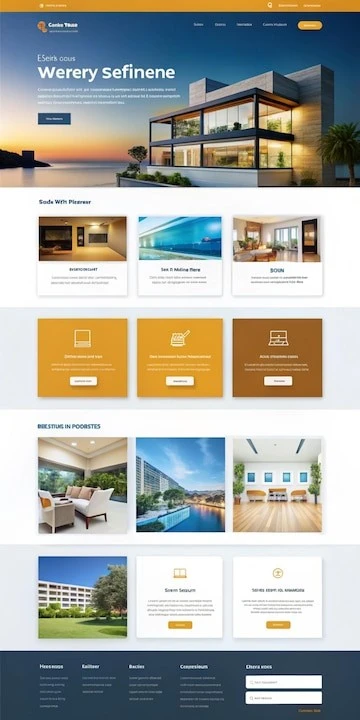
A template-based real estate website can launch in 2 to 4 weeks. A custom brokerage site typically takes 6 to 12 weeks. A full marketplace or enterprise-grade PropTech platform runs 6 to 12 months or longer, depending on integrations, AI features, and the size of the listing database. The timeline is driven less by design and more by integrations, data migration, and QA.
Most real estate web development projects move through six phases:
- Discovery and requirements: Nail down audience, core user journeys, listing volume, and must-have integrations.
- UX and UI design: Wireframes, prototypes, mobile-first mockups, and design system.
- Architecture and tech stack: Choose frameworks, databases, search, hosting, and third-party APIs.
- Development and integrations: Build the frontend, backend, IDX/MLS feeds, CRM, payment gateways, and analytics.
- QA, performance, and security testing: Cross-browser, load, accessibility, penetration testing.
- Launch and post-launch optimization: Go live, monitor Core Web Vitals, iterate on conversion rates, and expand content.
How Do You Make a Real Estate Website Rank on Google?
A real estate website ranks on Google when it combines strong technical SEO (fast load times, clean URLs, structured data) with hyper-local content (neighborhood pages, market reports, school and commute guides) and consistent authority signals (backlinks, Google Business Profile, verified reviews). Listings alone don’t rank. Content about places and people does.
The biggest SEO mistakes we see in real estate web development projects are thin listing pages with duplicate MLS copy, missing schema markup, slow map-heavy pages, and zero investment in content outside of property feeds. Fix those four, and you’re ahead of most competitors.
Bake these into your build from day one:
- Server-side rendering or static generation so listing and location pages are crawlable.
- Structured data (Schema.org RealEstateListing, LocalBusiness, FAQPage) on every relevant template.
- Unique, human-written copy on neighborhood and city landing pages.
- Internal linking between listings, neighborhoods, guides, and blog posts.
- Fast Core Web Vitals scores and mobile usability green across the board.
How Do You Choose the Right Real Estate Website Development Company?
The right real estate website development company has shipped real estate or PropTech projects before, understands IDX/MLS integrations, writes clean code you can maintain, and measures success in leads and closings, not design awards. Ask for case studies with traffic and conversion numbers, not just screenshots of pretty homepages.
A practical shortlist of questions to ask any real estate web development services provider:
- Can you show live real estate websites you’ve built, with performance and lead metrics?
- How do you handle IDX/MLS or regional feeds like Property Finder and Bayut?
- Which CRMs, payment gateways, and marketing tools have you integrated before?
- How do you approach SEO, Core Web Vitals, and mobile performance from day one?
- What does your post-launch support, maintenance, and iteration process look like?
If you’re evaluating agencies across the Middle East, our rundown of top web development companies in UAE is a useful starting point.
Common Real Estate Website Development Mistakes to Avoid
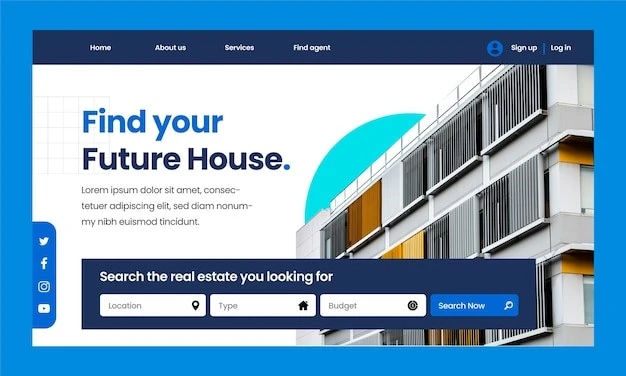
Most real estate websites underperform for the same handful of reasons: slow performance on mobile, broker-owned domains that kill portability, missing or weak IDX integrations, ignored SEO, and lead forms that no one ever tests. Fix these early and you’ll outperform most of your competition before your first paid ad runs.
- Building on a broker-owned subpage. If you change brokerages, you lose your SEO equity, backlinks, and often the domain itself. Always own your own domain.
- Skipping mobile-first design. Most searches and most leads come from phones. Desktop-first layouts fail where it matters most.
- Treating the site like a brochure. A real estate website is a lead-generation tool. Every page should have a clear next step.
- Ignoring site speed. Photo- and map-heavy pages are notorious for bad Core Web Vitals. Invest in CDN, lazy loading, and image optimization.
- Forgetting analytics and CRO. Launch is not the finish line. Track heatmaps, form drop-offs, and conversion rates, and improve them every quarter.
Conclusion: Build a Real Estate Website That Works as Hard as You Do
Real estate website development in 2026 is the difference between a business that quietly loses leads every day and one that compounds traffic, trust, and closings over time. The baseline has moved: fast mobile-first performance, IDX/MLS data, AI-powered search, and CRM-connected lead capture are no longer differentiators. They’re the price of admission.
The real win comes from going one layer deeper: hyper-local content, 3D virtual tours, conversational AI, and a tech stack that scales with you. Whether you’re a solo agent protecting your brand or an enterprise building the next Zillow, the investment you make in your website today becomes the asset your business runs on tomorrow.
If you’re planning to revamp an existing real estate site or build a new one from scratch, our team at StruqtIO helps brokerages, PropTech startups, and property management firms ship production-grade real estate websites that rank, convert, and scale. Get in touch to talk through your project.
Frequently Asked Questions
| What is real estate website development? Real estate website development is the process of designing, building, and launching a web platform where users can browse property listings, connect with agents, and complete transactions online. Modern real estate web development includes IDX/MLS integration, AI-powered search, CRM connections, 3D virtual tours, and analytics tools that turn visitors into qualified leads. |
| How much does real estate website development cost in 2026? Real estate website development costs typically range from $500 to $3,000 for a basic template-based site, $5,000 to $25,000 for a custom WordPress brokerage site, $25,000 to $75,000 for a mid-market custom build, and $75,000 to $250,000+ for an enterprise marketplace or PropTech platform. Final pricing depends on features, integrations, and the complexity of your listing data. |
| How long does it take to build a real estate website? Template-based real estate websites launch in 2 to 4 weeks. Custom brokerage sites typically take 6 to 12 weeks. Full marketplaces or enterprise PropTech platforms usually take 6 to 12 months or more, driven mostly by integrations, data migration, and QA rather than design. |
| What features should every real estate website include? Every real estate website should include IDX/MLS integration, advanced search and map-based filters, mobile-first speed-optimized design, a high-quality photo and video gallery, CRM-connected lead capture forms, user accounts with saved searches, and easy contact options like click-to-call and WhatsApp. Advanced features like AI property recommendations, 3D virtual tours, and chatbots offer a strong competitive edge. |
| Is WordPress good for real estate website development? Yes, WordPress is a solid choice for solo agents, small brokerages, and content-heavy sites because it’s flexible, SEO-friendly, and has mature IDX and real estate plugins. For high-traffic marketplaces or PropTech platforms with complex search, AI, and integrations, a fully custom stack built on frameworks like Next.js or .NET usually performs and scales better long-term. |
| How do you make a real estate website rank on Google? To rank a real estate website on Google, combine strong technical SEO (fast load times, structured data, clean URLs), hyper-local content (neighborhood guides, market reports, school and commute pages), and authority signals like backlinks, Google Business Profile optimization, and verified reviews. Thin, duplicate MLS listing pages alone won’t rank. Original content and fast, mobile-friendly pages will. |
| Do I need IDX or MLS integration for my real estate website? In the US, IDX or MLS integration is essentially required for any serious real estate website because it lets you display live, comprehensive listings from the broader market. In other regions, the equivalent is integration with local portals like Property Finder, Bayut, or Dubizzle. Without live feeds, users typically leave for a competitor that has them. |