The UAE ecommerce market has grown into one of the largest in the Middle East, and Noon sits at the centre of it. For founders, product managers, and enterprise teams evaluating what it takes to build a marketplace of that scale, the question is rarely “should we?” — it is “what does it actually take?”
This guide breaks down exactly how an app like Noon is architected: the features that matter, the technology stack behind a multi-vendor marketplace, a realistic view of cost drivers, and the trade-offs that decide whether the product ships in six months or twenty. Written for teams evaluating custom development rather than off-the-shelf platforms.
What is Noon and Why It Dominates UAE Ecommerce

Noon launched in 2017 as a joint venture between Emirati businessman Mohamed Alabbar and Saudi Arabia’s Public Investment Fund. It positioned itself as the Middle East’s home-grown answer to Amazon — a general-purpose marketplace built for the region’s payment habits, delivery expectations, and language preferences.
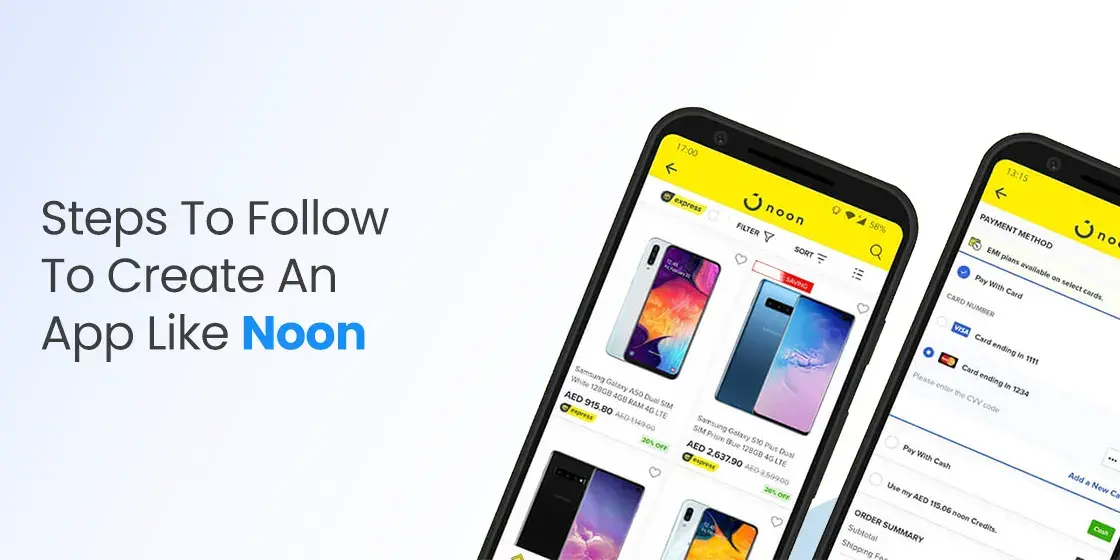
Today, Noon operates across the UAE, Saudi Arabia, and Egypt. It sells across categories including consumer electronics, fashion, groceries, beauty, and household goods. Its Noon One subscription programme (which replaced the earlier Noon VIP in 2023), Noon Food delivery arm, and Noon Minutes 15-minute grocery service show how the platform has evolved from a pure marketplace into a broader ecosystem. Noon also acquired fashion retailer Namshi from Emaar in February 2023, adding a dedicated fashion vertical to the group.
For founders looking at Noon as a reference point, three things stand out:
- Multi-vendor architecture at scale. Noon supports thousands of independent sellers with distinct inventory, pricing, and fulfilment obligations.
- Regional payment integration. Cash-on-delivery is treated as a first-class citizen alongside cards and digital wallets, reflecting UAE payment habits.
- Localised UX. Arabic-English toggles, right-to-left layouts, and city-level delivery windows are baked into the core experience.
Apps Like Noon: The Competitive Landscape
Before committing to a Noon-style build, it is worth understanding where similar apps have differentiated. Each of the following operates in the same UAE ecommerce space but targets a distinct segment:
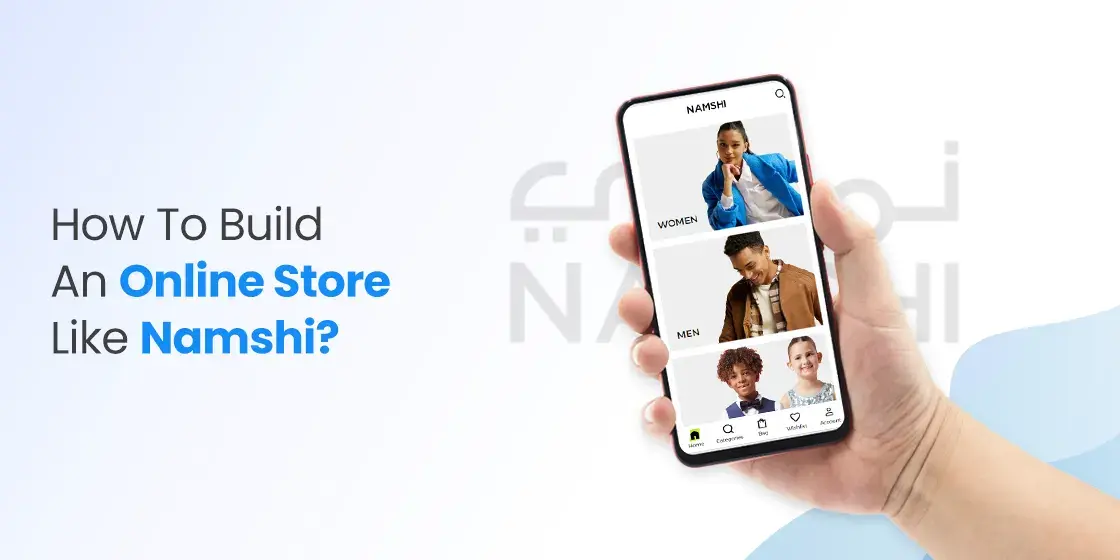
- Namshi. Fashion and lifestyle only, with a stronger focus on curated brands. Now part of the Noon group following the 2023 acquisition, but operates as a separate brand. If your product is closer to Namshi than Noon, read our dedicated guide on how to build an ecommerce app like Namshi.
- Amazon.ae. The global giant, formerly Souq. Deeper logistics infrastructure but less regional customisation than Noon.
- Carrefour. Grocery-led with a physical hypermarket network behind it — a hybrid retail model. See our breakdown of how to build an ecommerce app like Carrefour.
- SHEIN. Ultra-fast-fashion at low price points, powered by an agile supply chain. Reviewed in our guide on how to build an app like SHEIN.
- Lulu, Cartlow, Mumzworld. Category specialists — grocery, refurbished electronics, and mother-and-baby respectively.
If you are still deciding which model fits your idea, our list of the best online shopping apps in the UAE compares each on features and user base.
Must-Have Features for an App Like Noon
A marketplace app is really three apps in one — a buyer experience, a seller dashboard, and an admin control panel. Cutting corners on any of the three creates operational debt you will pay for later.
Buyer App Features
- Frictionless onboarding. Phone or email sign-up with OTP; social login as a secondary option. Guest checkout for first-time buyers.
- Smart search and filtering. Category trees, price ranges, brand filters, ratings, and Arabic search support. Autocomplete and typo tolerance are non-negotiable.
- Product detail pages. High-resolution imagery, 360° views, video, size guides, seller ratings, and cross-sell recommendations.
- Cart and wishlist. Persistent across sessions and devices. Wishlist should trigger back-in-stock and price-drop alerts.
- Multi-method checkout. Credit and debit cards, Apple Pay, Google Pay, Tabby, Tamara, and cash-on-delivery.
- Order tracking. Real-time status updates, delivery ETAs, driver location on the day of delivery.
- Reviews and ratings. Verified-purchase badges, photo reviews, seller-level scores separate from product-level scores.
- Push notifications. Segmented — promotional, transactional, and abandoned-cart flows treated separately with opt-in controls.
- Loyalty programme. Points, tiered membership, or a Noon One-style subscription that bundles free delivery across the marketplace and adjacent services.
Seller App Features
- Product catalogue management. Bulk upload via CSV, image handling, variant management (size, colour, SKU).
- Inventory and pricing controls. Real-time stock sync, promotional pricing, scheduled discounts.
- Order management. Accept, ship, refund, and dispute workflows with clear SLAs.
- Analytics dashboard. Conversion, best-sellers, cart abandonment, refund rate.
- Payouts and financials. Automated commission calculation, VAT handling, scheduled settlements.
Admin Panel Features
- Seller onboarding and vetting. KYC checks, trade licence verification, product approval workflows.
- Category and content moderation. Ban lists, prohibited items, review moderation.
- Financial reconciliation. Commission structures, refund policies, chargeback handling.
- Marketing and promotions engine. Coupon codes, flash sales, homepage merchandising.
- Fraud detection. Anomaly detection on returns, chargebacks, and account behaviour.
Tech Stack for an App Like Noon

The right stack depends on team size, hiring market, and long-term maintenance appetite. That said, a marketplace of Noon’s complexity typically settles on the following:
Frontend (Mobile)
- React Native or Flutter for cross-platform builds — the pragmatic choice for most startups. See our comparison of cross-platform mobile app development frameworks.
- Swift for native iOS and Kotlin for native Android — the right call if performance, camera access, or AR features are core to the experience.
Frontend (Web)
- Next.js or Nuxt for server-side rendering and SEO — critical for a marketplace that lives or dies by organic traffic.
Backend
- Node.js (Express or NestJS) for real-time features and a shared JavaScript stack.
- Django or Ruby on Rails for rapid MVP development.
- Java (Spring Boot) or Go for services that need high throughput — payments, order processing, search.
Database and Search
- PostgreSQL or MySQL as the primary relational store for orders, users, transactions.
- MongoDB for product catalogue and unstructured seller data.
- Elasticsearch for product search, filtering, and recommendations.
- Redis for session management, cart persistence, and caching.
Cloud and Infrastructure
- AWS, Google Cloud, or Azure for compute and storage.
- CloudFront or Cloudflare for CDN — mandatory for image-heavy product pages.
- Kubernetes for orchestrating microservices as the platform scales.
Third-Party Integrations
- Payment gateways: Checkout.com, Network International, PayTabs, Telr for card processing; Tabby and Tamara for buy-now-pay-later.
- SMS and OTP: Twilio, MessageBird, or Unifonic for regional SMS deliverability.
- Analytics: Firebase, Mixpanel, or Amplitude for user behaviour; Google Analytics 4 for acquisition.
- Logistics: APIs from Aramex, Fetchr, or in-house fleet management for last-mile delivery.
How to Build an App Like Noon: Step-by-Step
Building a marketplace at Noon’s level of complexity is not a linear engineering exercise. It is a product, operations, and infrastructure problem being solved in parallel, and the sequence you tackle them in largely decides whether the launch is a soft success or an expensive relaunch. The eight steps below reflect how experienced teams actually approach the build.
1. Start With Market and Competitor Research
Noon succeeded because it read the regional market correctly at a specific moment — Amazon had not yet fully absorbed Souq, cash-on-delivery still dominated, and Arabic-first UX was underserved. The lesson is not to copy Noon; it is to find the equivalent wedge for your product today.
Do three things before writing a product spec:
- Read the one-star reviews. App Store and Google Play reviews for Noon, Namshi, Amazon.ae, and Carrefour are a running feed of unmet customer needs. Categorise the complaints — delivery, returns, product quality, search relevance — and the pattern that emerges is your opportunity map.
- Talk to potential users. Not a survey. Actual conversations, in the language they shop in. Ask what they abandon carts over and what makes them re-open an app.
- Map the seller side. Talk to merchants who sell on existing marketplaces. Their frustrations — commission structures, payout delays, dispute handling — are usually where the differentiation is easiest to build.
Skip this step and you will build a technically competent app for a market that does not need it.
2. Define a Ruthlessly Narrow MVP Scope
The single most common failure mode in marketplace development is shipping too much, too soon. Every additional feature at launch multiplies the surface area for bugs, adds weeks to QA, and delays the moment you get real user data.
A defensible Noon-style MVP looks like this:
- One category or vertical. Electronics, fashion, or beauty — pick one. Noon launched with a narrower range than it operates today.
- One city. Dubai or Abu Dhabi, not the whole GCC.
- Buyer app with the core loop only. Search, product detail, cart, checkout, order tracking. No wishlist-sharing, no live chat, no video reviews at v1.
- Seller dashboard, not seller app. Web-based catalogue and order management is enough at launch. Native seller apps come later.
- One payment method plus cash-on-delivery. Card processing through a single gateway. Add Apple Pay, Tabby, and Tamara in the next release.
- One shipping partner. Aramex or Fetchr via API. In-house logistics is a round-two decision.
- Admin panel with the minimum controls. Seller approval, product moderation, refund processing, basic reporting.
Anything beyond this list is scope creep dressed up as ambition.
3. Design the UX Before Writing Code
Wireframe every screen before a developer touches a keyboard. This sounds obvious and it is almost always skipped.
- Prototype in Figma to a level where users can complete a full purchase flow. Test it with real users from your target segment. You will find flow-breaking assumptions in the first two sessions.
- Design Arabic and English in parallel. Right-to-left support is not a translation layer — it affects icon placement, navigation direction, form alignment, and typography. Retrofitting RTL after launch is significantly more expensive than building it in from the start, because it touches nearly every screen.
- Design the seller dashboard with the same attention as the buyer app. Marketplaces die when sellers churn. A confusing catalogue upload flow or an opaque payout screen will cost you supply-side liquidity faster than any buyer-side bug.
- Establish a design system. Colours, typography, spacing, and components documented so that future features stay consistent without a designer having to re-approve every screen.
4. Choose the Development Approach and Stack
By this stage, the MVP scope tells you most of what you need to decide the stack. The two big questions are cross-platform versus native, and monolith versus microservices.
Cross-platform (React Native or Flutter) is the default for cost-conscious teams. One codebase, both platforms, faster iteration. This is the right call for the majority of ecommerce marketplaces because performance is not the differentiator — trust, catalogue, and delivery are.
Native (Swift for iOS, Kotlin for Android) makes sense when performance-critical features are core: AR try-on, heavy camera use, real-time video, or complex animations. If your product does not depend on those, native doubles frontend cost without a proportional user benefit.
Monolith versus microservices is often decided the wrong way. A microservices architecture at MVP stage adds operational complexity that a small team cannot support. Start with a well-structured monolith. Break out services (payments, search, notifications) once the team, traffic, and codebase have grown to the point where a monolith slows delivery.
Our comparison of cross-platform mobile app development frameworks and the guide on how to choose a mobile app development company walk through the trade-offs in more depth.
5. Build in Two-Week Sprints With Working Software Each Cycle
Agile is not a philosophy statement; it is a delivery discipline. Two-week sprints, working software at the end of each, and a clear definition of done that includes tests and deployment.
One workable sequence looks like this — the exact ordering depends on team composition and dependencies:
- Early sprints: Authentication, user model, basic product catalogue.
- Then: Search and product detail. Elasticsearch integration is not a plug-and-play job — start early.
- Then: Cart, checkout, and payment integration. This is where users lose trust fastest when things break.
- Then: Order management, seller dashboard basics, admin panel.
- Then: Notifications, order tracking, review system.
- Final sprints: Hardening, load testing, security review, beta launch prep. These are not “polish” — they are the difference between a beta that generates real learnings and one that generates support tickets. Do not compress them.
6. Integrate Payments, Logistics, and Analytics Early
Third-party integrations are the schedule risk that most plans underestimate. Payment integration in the UAE is not plug-and-play.
- Card processing. Expect several weeks for gateway certification with Checkout.com, Network International, PayTabs, or Telr, depending on the gateway and how prepared your documentation is. This includes PCI compliance review, sandbox testing, and production credentialing.
- Cash-on-delivery reconciliation. COD remains a significant share of UAE ecommerce transactions. Building the reconciliation workflow — driver cash handling, failed-delivery retry logic, refund-to-wallet flows — is a workstream in its own right, and it is usually forgotten until the operations team asks about it.
- Buy-now-pay-later. Tabby and Tamara have well-documented APIs, but each requires its own commercial agreement. Start those conversations early, not late.
- Logistics APIs. Aramex, Fetchr, and Naqel all offer courier integration. Test the actual delivery flow end-to-end before launch, including edge cases like address correction and failed handovers.
- Analytics. Firebase, Mixpanel, or Amplitude for product analytics. Google Analytics 4 for acquisition. Instrument the funnel from day one — you cannot fix what you are not measuring.
Kick these workstreams off in parallel with core development, not after it. Our review of the best payment gateways in the UAE covers integration options and commercial terms.
7. Test Rigorously — And Not Just the Happy Path
QA on a marketplace app has to cover more surface area than most teams plan for:
- Unit and integration tests on every service, with coverage targets enforced in CI.
- Load testing on search, checkout, and order creation. Simulate peak traffic — Black Friday, Ramadan, Eid — before you experience it in production.
- Manual QA on a range of real devices. Not just the latest iPhone. Test on mid-tier Android devices with slower network conditions, because that is what a large share of your users are on.
- Payment flow penetration testing. Mobile app security reviews on the checkout and PII-handling paths should happen before launch, not after. A single publicised payment vulnerability can end a marketplace’s credibility.
- Seller-side testing. Onboard friendly merchants during beta. Their feedback on catalogue upload, order fulfilment, and payout clarity is worth more than any internal QA cycle.
- Localisation QA. Every Arabic screen, tested by a native Arabic speaker. Translation quality varies enormously by vendor, and generic services routinely produce awkward or incorrect ecommerce copy.
8. Launch Softly, Measure Everything, Iterate Weekly
A hard launch on a marketplace app is almost always a mistake. Soft-launch to a limited audience — one emirate, one category, users acquired through owned channels — and use the first weeks to fix what you find.
Watch these metrics closely:
- Install-to-first-purchase conversion. A low rate points to friction in onboarding, search, or checkout — benchmark against your own early cohorts rather than a fixed number.
- Cart abandonment rate. A high abandonment rate signals checkout friction, unexpected costs, or payment failures — worth investigating whatever the exact number.
- Seller onboarding time. From application to first listing. The faster a seller can go live, the better your supply-side growth.
- Search-to-result relevance. Track zero-result searches and clickthrough on top results. Both are direct signals for Elasticsearch tuning.
- Order fulfilment SLA. Time from order to dispatch, and from dispatch to delivery. Sellers below your SLA need coaching or removal.
- Support ticket volume by category. Payment failures, delivery issues, product complaints. Ticket categories are your product roadmap for the next quarter.
Fix the leaks in the funnel before spending on paid acquisition. Spending on ads to drive users into a broken checkout is the fastest way to burn a marketing budget with nothing to show for it.
What Drives the Cost of Building an App Like Noon?
The honest answer to “how much does it cost” is: it depends on scope, team location, and how much of the stack is custom versus off-the-shelf. Rather than quote a single number, it is more useful to understand what moves the cost up or down.
| Build Tier | What You Get |
| MVP | Single-platform app, one category, basic seller dashboard, one payment gateway, essential admin controls. |
| Mid-Tier Marketplace | iOS and Android apps, multi-vendor support, multiple payment methods including BNPL, logistics integration, loyalty programme. |
| Full-Scale Marketplace | Multi-country, Arabic-English, personalisation engine, subscription tier, in-house logistics dashboard, advanced fraud detection. |
The final quote for any of these tiers depends on:
- Team location. UAE-based teams cost more than offshore, but reduce coordination overhead on a market-specific product.
- Native vs cross-platform. Native effectively doubles frontend engineering effort.
- Feature depth. Personalisation, recommendation engines, and fraud detection can add materially to backend cost.
- Third-party licensing. Search infrastructure, analytics, and payment processing all carry recurring costs.
- Post-launch. Budget a meaningful share of build cost annually for maintenance, feature additions, and infrastructure scaling — the exact figure depends on how actively the product evolves.
For a deeper breakdown by feature and platform, our detailed guide on ecommerce mobile app development cost covers the full picture with worked examples.
How Long Does It Take to Build an App Like Noon?
A functional MVP is typically a matter of months rather than weeks, with a team large enough to cover mobile, backend, and design in parallel. A production-grade multi-vendor marketplace with Arabic support, BNPL, and logistics integration is a materially longer build.
Two things add time consistently: payment certification, which takes real calendar time regardless of budget, and seller-side onboarding UX, which teams almost always underestimate because it feels like an internal tool.
Common Pitfalls When Building a Noon-Style App
The technical challenges are well-understood. The ones that catch teams out are operational:
- Underestimating seller onboarding. A marketplace without sellers is a website. Budget as much design attention on the seller dashboard as on the buyer app.
- Delaying Arabic support. Right-to-left layouts touch every screen. Ship both languages from day one or accept an expensive retrofit later.
- Building logistics too early. Start with a third-party courier API. Only build in-house fleet software once volume justifies it.
- Ignoring cash-on-delivery reconciliation. COD remains a significant share of UAE ecommerce orders. Reconciliation, driver cash handling, and failed-delivery workflows need dedicated design.
- Skimping on search. Users abandon within seconds if search returns irrelevant results. Elasticsearch tuning is a specialist skill worth paying for.
Building Your Noon-Style App With StruqtIO
StruqtIO is a custom software development company based in the UAE. We build ecommerce and marketplace platforms from the ground up — no templates, no white-labelled shortcuts. Our teams have delivered multi-vendor marketplaces, custom payment integrations, and Arabic-first UX for clients across the region.
If you are evaluating whether to build in-house, offshore, or with a UAE partner, we are happy to walk through the trade-offs on a call. You can also read about our approach to ecommerce software development and marketplace app development.
Final Thoughts
Building an app like Noon is not primarily a technical challenge — it is a product and operations challenge with a technical component. The teams that succeed are the ones that pick a defensible niche, design for the seller side as carefully as the buyer side, and treat Arabic and cash-on-delivery as first-class requirements rather than post-launch afterthoughts.
If you are at the stage of turning a marketplace idea into a build plan, we would be glad to help you scope it. Reach out through the contact form or book a call — we will walk through the architecture, the timeline, and the honest trade-offs.

Empower your digital journey with StruqtIO - Your dedicated partner for cutting-edge custom software development, innovation, and digital transformative solutions. Harness the power of technology to elevate your business and redefine your digital landscape today.